
Quick Answer:
A Louisiana law firm website should be reviewed whenever the firm changes attorneys, offices, or practice areas, and at least once a year. Under Rule 7.6(b) of the Louisiana Rules of Professional Conduct, every firm website must list the jurisdictions where its lawyers are licensed and at least one bona fide office location. Websites are exempt from LSBA filing under Rule 7.8(g) and must still comply with the advertising rules, including the rule against implying the firm practices in an area it no longer handles.
Last reviewed: October 2026
Your law firm may have changed a lot over the past few years. You may have added attorneys, dropped a practice area, moved offices, changed your intake process, started using AI, or become far more selective about the clients you want to represent.
Your website may still be telling the old story.
That’s what I mean when I say your website has a memory.
Every attorney bio you forgot to update, every practice page describing work you no longer prioritize, every old office location, and every piece of outdated copy remains part of the digital version of your firm until someone fixes it.
Going into 2027, I’d pay very close attention to that.
Another year on the calendar is no reason to redesign your website. It is a good reason to review it. Your website should accurately represent the firm you’re running now and support the firm you’re building next.
For Louisiana attorneys, there’s another layer to consider. Communications about your legal services are subject to the Louisiana Rules of Professional Conduct, and Rule 7.6 speaks to law firm websites directly.
That gives us a very good reason to stop treating the website like something we build once and admire from a distance.
Table of Contents
Your website may be describing a firm that no longer exists
I want you to open your website and read it as though you’ve never met anyone at your firm.
- Does the homepage describe what you’re focused on today?
- Do your practice-area pages reflect the matters you’re actively trying to grow?
- Are all of the attorneys still with the firm?
- Are their biographies current?
- Are your office locations accurate?
- Does your site explain what happens after someone contacts you?
- Does the language still sound like you?
A website can work perfectly well from a technical standpoint and still be strategically outdated.
That gap matters because prospective clients don’t know everything that has changed behind the scenes. They make decisions based on what you’ve made available to them.
The ABA made a similar point in a September 2026 Law Practice Today article on law firm websites. It suggests taking a fresh look at the site from a prospective client’s point of view. Can visitors tell whether the firm handles a problem like theirs? Is the site written in language clients actually use? Does it give them reasons to feel confident in the firm?
Each of those is a business question, and each one affects whether a visitor picks up the phone.
An outdated bio can quietly weaken an attorney’s authority
Attorney bios deserve more attention than they usually get.
You may have an attorney who now leads a major practice area, serves on boards, speaks at conferences, publishes articles, or has built significant experience that isn’t mentioned anywhere on the website.
Meanwhile, the bio may still read like someone copied it from a résumé six years ago.
That’s a missed opportunity.
A bio is one of the first places a potential client, referral partner, recruit, or business contact goes to size up the people behind the firm. It should reflect the attorney’s current experience, roles, and focus.
Accuracy also matters from a professional responsibility standpoint. Louisiana’s Rule 7.6(b) requires firm websites to disclose every jurisdiction where the firm’s lawyers are licensed. When an attorney joins, leaves, or gains a new license, that disclosure may need to change too.
Departed attorneys deserve a look as well. In Formal Opinion 10-457, the ABA advised that website information should be updated regularly so it does not mislead visitors (summary by Hinshaw & Culbertson). Louisiana’s Rule 7.10(e) also bars using the name of a lawyer formerly associated with a firm in the firm’s communications while that lawyer is not actively practicing there. Rule 7.10(g) allows limited exceptions for deceased or retired members.
Updating attorney bios is part of maintaining an accurate public presence.
Your practice areas may be sending the wrong business signal
Your firm’s priorities can change faster than your website.
Maybe you once handled a broad mix of matters and now want to concentrate on a smaller number of higher-value practice areas. Maybe an attorney joined the firm and brought a new capability. Maybe you’ve become known for a particular type of case, yet that work is buried three clicks into the site.
Your website needs to catch up.
I see this as a positioning issue. Your practice-area structure tells both people and search systems what your firm considers important. A page that exists only because “we’ve always had one” isn’t much of a strategy.
In Louisiana, it can also be a compliance issue. Rule 7.2(c)(3) prohibits a firm from stating or implying that it currently practices in an area when that is no longer the case. A practice page for work you stopped taking two years ago can do exactly that.
I’d review every major practice page and ask whether the firm still wants that page representing its priorities in 2027. I’d also check whether the content explains the practice clearly enough for someone who doesn’t speak lawyer all day.
Specific language helps a prospective client judge fit much faster than broad promises of “quality legal services.” That clarity also makes your website easier for search engines and AI systems to interpret, because you’re plainly describing who you help, what you handle, and where you practice.
Your contact experience may remember an older version of your firm too
A law firm can spend thousands of dollars making a website look polished and then send a potential client through a contact process that feels like it was built during the dial-up era.
Try this:
- Fill out your own contact form on your phone.
- Book an appointment through your scheduling tool.
- Read the confirmation message.
- Check where the inquiry actually goes.
- Look at what information you ask someone to share before you’ve spoken with them.
Then ask yourself whether the process still matches how your firm wants to handle prospective clients.
The ABA’s Law Practice Today article notes that online scheduling, intake forms, and automated confirmations can make it easier to reach your firm, provided they work well. It also recommends reviewing the site with the applicable ethics rules in mind, including how prospective clients interact with it.
That last point carries real weight. In Formal Opinion 10-457, the ABA explained that when a website invites visitors to submit information about a possible representation, those visitors can become prospective clients under Rule 1.18, which carries confidentiality duties. The ABA advised that firm websites include appropriate warnings to avoid misunderstandings (summary by Hinshaw & Culbertson).
This is especially important as more firms add automation and AI-powered intake tools. Technology should reduce friction for the people trying to reach you. Any tool that adds confusion deserves a second look.
AI makes accuracy more important
AI will be part of more law firms’ operations in 2027, and that gives firms another reason to get serious about the information they publish.
In July 2024, the ABA issued Formal Opinion 512 on generative AI tools in legal practice. It explains that lawyers using these tools remain responsible for their existing ethical duties, including competence, confidentiality, communication, supervision, candor, and reasonable fees. It also stresses understanding a tool’s capabilities and limits before relying on it.
The opinion addresses legal work. I apply the same principle to marketing.
AI can help your team brainstorm, organize information, analyze reports, draft content, and work more efficiently. Every piece of it still needs human review.
Your website content deserves the same oversight. Someone at the firm should know which information is current, which pages need review, which attorney statements have been approved, and what needs to change as the firm evolves.
I love a useful AI tool. I’m less enthusiastic about letting one become the most confident employee nobody remembers hiring.
Louisiana law firms also need to look at the advertising rules
A website audit for a Louisiana law firm has to include the Louisiana Rules of Professional Conduct that govern communications about legal services.
Rule 7.6(b) sets out what every firm website must show. It must list every jurisdiction where the firm’s lawyers are licensed, and it must disclose at least one bona fide office location. If an attorney with an out-of-state license leaves, or an office closes, those disclosures can be wrong the next morning.
Websites are exempt from the LSBA’s filing and review process under Rule 7.8(g). The LSBA is clear that exempt communications must still comply with the rules, and that lawyers remain responsible for making sure they do.
Two other rules speak directly to the problems in this article. Rule 7.2(c)(3) prohibits a firm from stating or implying that it currently practices in an area when that is no longer true. Rule 7.10(e) bars using the name of a lawyer formerly associated with the firm in its communications during any substantial period when that lawyer is not actively practicing there. An old practice page or the bio of an attorney who left two years ago can run into both.
Firms that run filed advertising, such as television, billboard, or print ads, should also know Rule 7.7(i). When a change in circumstances creates a substantial possibility that a filed ad has become misleading, the lawyer must promptly re-file it.
A note on authority: ABA formal opinions interpret the ABA Model Rules. Courts and bar regulators often look to them, but they do not bind Louisiana lawyers. The Louisiana Rules of Professional Conduct are the rules that apply here.
That’s why I keep marketing and compliance in the same conversation. Your website needs both.
This article is general information from a marketing agency and is not legal advice. For questions about a specific communication, contact LSBA Ethics Counsel.
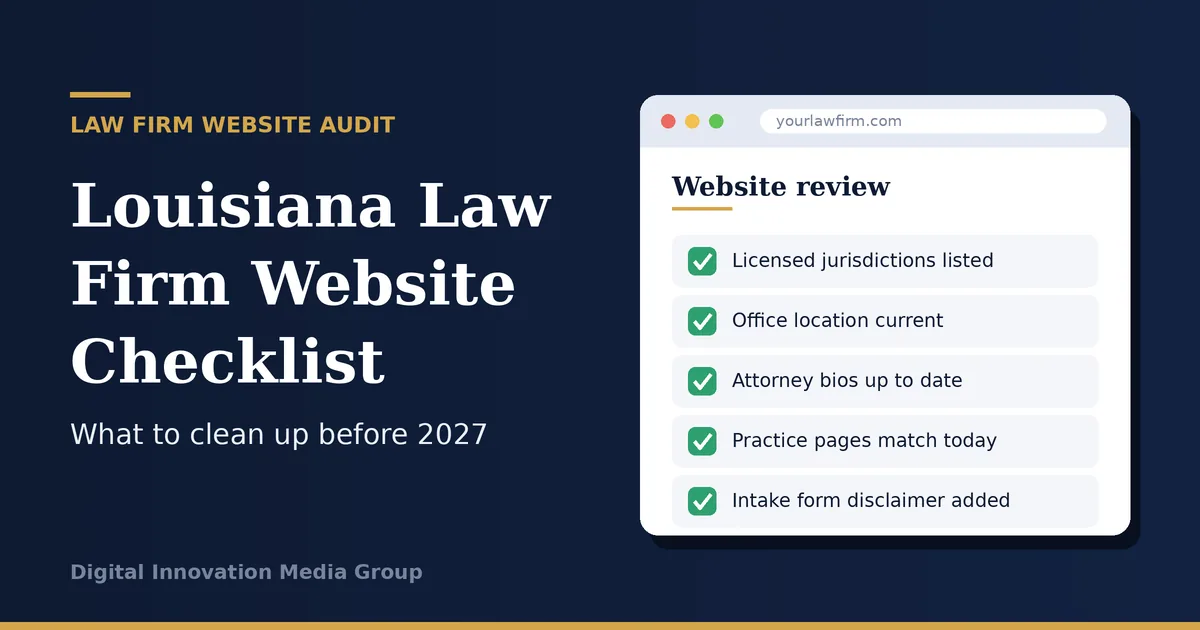
Louisiana law firm website checklist for 2027
Before you add another year of blogs, videos, landing pages, and campaigns to your current website, review the foundation first.
- Every jurisdiction where firm lawyers are licensed is listed (Rule 7.6(b))
- At least one bona fide office location is shown, and closed offices are removed (Rule 7.6(b))
- Every attorney listed still practices with the firm
- Bios reflect current roles, experience, licenses, and board service
- Practice pages match the work the firm takes today (Rule 7.2(c)(3))
- Retired practice areas are removed or redirected
- The homepage describes what the firm focuses on now
- Contact forms work on a phone and route to the right person
- Forms carry clear warnings that submitting information does not create an attorney-client relationship
- Any AI or chat tools have been tested and approved by someone at the firm
- Statements about past results are factually verifiable and not misleading (Rule 7.9(b)(3))
- Someone owns the website and reviews it at least once a year
Frequently asked questions
Do Louisiana law firm websites have to be filed with the LSBA?
No. Rule 7.8(g) of the Louisiana Rules of Professional Conduct exempts firm websites from the LSBA’s filing and review requirements. The website must still comply with the advertising rules.
What must a Louisiana law firm website disclose?
Under Rule 7.6(b), the website must list all jurisdictions where the firm’s lawyers are licensed and at least one bona fide office location. Rule 7.2(a)(2) explains how office locations are disclosed, by city or town.
How often should a law firm update its website?
Update it whenever attorneys, offices, or practice areas change, and give the full site a review at least once a year. ABA Formal Opinion 10-457 also advises firms to keep website information current.
Can a website contact form create obligations to a prospective client?
It can. ABA Formal Opinion 10-457 explains that website inquiries can create duties to prospective clients under Rule 1.18, including confidentiality. Clear disclaimers on the form help limit those duties.
Can a law firm use AI to write website content?
Yes, with human review. ABA Formal Opinion 512 makes clear that lawyers remain responsible for their ethical duties when they use generative AI. Every statement on the site should be checked for accuracy before it goes live.
Your website doesn’t know your firm changed unless you tell it
Your reputation keeps growing offline.
You develop deeper experience. You build relationships. You become more selective. You hire better people. You refine how you serve clients. You strengthen the firm.
Your website needs to keep pace with that growth.
One of the most common mistakes I see is a business that keeps investing in itself while its website stays frozen at an earlier stage. Eventually, a gap opens between the firm people experience after they hire you and the firm they see before they contact you.
I want your potential clients to meet the current version of your firm first.
At DIMG, we look at the whole picture of a law firm website: positioning, content, practice areas, user experience, SEO, technology, and the business goals the site needs to support.
If your firm has grown, changed, or become more focused while your website has stayed mostly the same, I’d welcome the chance to talk.
Schedule a consultation with DIMG, and we’ll look together at what your website is still saying about your firm, what no longer fits, and what to update before 2027.
Sources
- Louisiana State Bar Association, Lawyer Advertising and Solicitation. Filing requirements under Rule 7.7, exemptions under Rule 7.8, and links to the Lawyer Advertising Handbook.
- Louisiana Supreme Court, Louisiana Rules of Professional Conduct, Rules 7.1 through 7.10, Information About Legal Services, current version posted by the LSBA (amendments through January 1, 2022). Rules 7.2, 7.6, 7.7(i), 7.8(g), 7.9, and 7.10.
- American Bar Association, Law Practice Today, “What Does Your Law Firm’s Website Say to Prospective Clients?”, September 2026.
- American Bar Association Standing Committee on Ethics and Professional Responsibility, Formal Opinion 10-457, Lawyer Websites, August 2010. Listed in the ABA ethics opinion index and summarized by Hinshaw & Culbertson LLP.
- American Bar Association Standing Committee on Ethics and Professional Responsibility, Formal Opinion 512, Generative Artificial Intelligence Tools, July 29, 2024. Full text hosted by the Minnesota Lawyers Professional Responsibility Board.


